

What Does Internet of Things Mean? Definition and Core Principles
The IoT abbreviation stands for Internet of Things. It describes a network of physical devices, machines or components equipped with sensors, software and network connectivity. These devices collect data, exchange it with other systems or central platforms and respond automatically to defined events.
Unlike traditional IT systems, IoT devices often operate without direct human interaction. Temperature sensors report deviations, machines signal maintenance requirements and logistics systems track goods in real time. Reliable networks, clear addressing and secure data transmission are essential prerequisites for this functionality.
IoT History – From Early Concepts to Connected Reality
The IoT history goes back further than expected. Early ideas emerged as early as the 1980s and 1990s, when networked systems were first used in industrial and research environments. The term Internet of Things itself was coined in 1999 by Kevin Ashton in the context of RFID-based supply chain concepts.
However, widespread adoption came much later. Falling sensor costs, more powerful networks, cloud computing and the introduction of IPv6 created the technical foundation for scalable IoT solutions. These developments form the basis of today’s rapid IoT development.
Technical Foundations of the Internet of Things
For the internet of the things to function reliably, several technical layers work together:
Sensors and actuators to collect data or trigger actions
Network infrastructure such as Ethernet, WLAN, mobile networks or LPWAN
Communication protocols like MQTT or CoAP for efficient data exchange
Backend systems and cloud platforms for data processing and storage
Security mechanisms to protect devices, access and information
Especially in B2B environments, scalability, reliability and security are critical. Poorly protected IoT infrastructures can quickly become entry points for cyber threats.
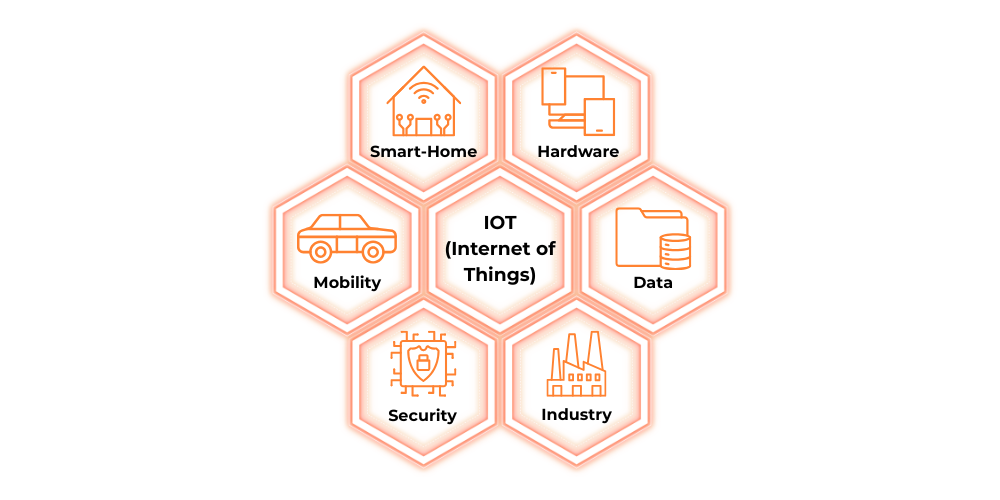
IoT Application Areas in Business Environments
The range of IoT application areas is broad and spans multiple industries. Particularly relevant use cases for businesses include:
Industry and Manufacturing
In industrial settings, IoT forms the basis for connected production environments. Machines monitor their own condition, detect wear early and reduce unplanned downtime. Predictive maintenance helps lower costs and improve system availability.
Logistics and Supply Chain
Sensors track location, temperature or shock exposure of goods. This provides transparency across supply chains and enables faster responses to deviations.
Buildings and Infrastructure
Smart building technologies automatically control heating, lighting and access systems. This reduces operating costs and simplifies facility management.
IT and Data Centers
In server rooms, IoT systems monitor temperature, humidity and power consumption. Potential risks can be identified early, helping to maintain stable and secure operations.
H2: Internet of Things Development – Trends and Challenges
The internet of things development continues to progress at a rapid pace. The number of connected devices is increasing steadily, while demands on data processing and security are growing at the same time. Key trends include:
a rising number of networked endpoints
increased integration of AI-based analytics
edge computing for local data processing
higher requirements for network performance
Challenges arise primarily from heterogeneous device landscapes, long lifecycles in industrial environments and the need for secure operation over many years. This highlights the importance of a robust and well-planned IT infrastructure.
IoT and IT Infrastructure – What Businesses Should Consider
A reliable IoT solution depends heavily on the underlying IT infrastructure. Networks must be stable, scalable and secure. At the same time, hardware components should remain available over the long term to avoid outages and costly replacements.
In IoT environments, devices are often operated for many years. Using professionally refurbished network hardware can therefore be a cost-effective option without compromising on quality or reliability.
Conclusion – IoT as a Core Element of Modern Enterprise IT
The Internet of Things is no longer just a technological trend. It has become a key component of modern business strategies, driving automation, efficiency and transparency. Companies that consider IoT development early in their IT planning and invest in a stable infrastructure lay the groundwork for reliable, connected systems in the long term.
Buy IOT components at IT-Market.com
A stable IT foundation is essential for operating IoT environments reliably. At IT-Market.com, you will find new and professionally refurbished network hardware for business use – tested, readily available and backed by up to three years of warranty. Our experienced team is happy to support you in selecting suitable hardware and planning your IT infrastructure.
FAQ – Frequently Asked Questions About the Internet of Things
What is meant by IoT?
IoT refers to the networking of physical devices via the internet, enabling them to collect, exchange and process data automatically.What are examples of IoT?
Typical examples include connected machines in manufacturing, sensors in warehouses, smart building systems or monitoring solutions in data centers.What are IoT devices?
IoT devices are physical components such as sensors, machines or control units equipped with software and network connectivity that can communicate autonomously.